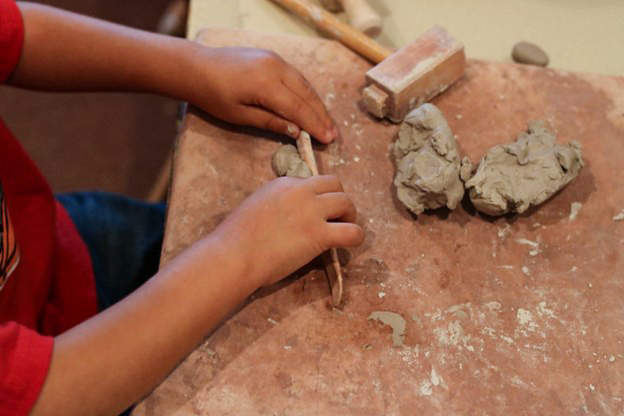
Clay play is not just a fun activity; it offers numerous developmental benefits for children. This blog explores how playing with clay can enhance fine motor skills and creativity.
Engaging with clay allows children to express themselves artistically while developing hand-eye coordination and dexterity. This blog highlights the importance of incorporating clay play into daily activities.
Here are some of the surprising benefits of clay play:
Clay play is a wonderful open-ended learning experience in early childhood. It allows children to explore, create, experiment, and express themselves while developing skills across many areas of development.
Manipulating clay, squeezing, rolling, pinching, flattening, twisting, and moulding; strengthens the small muscles in children’s hands and fingers. These skills support later activities such as writing, drawing, cutting, and using utensils.
Clay has no “right answer.” Children can turn it into anything they imagine; a person, animal, house, food, or completely abstract creation. This encourages creative thinking and self-expression.
The texture, softness, resistance, and temperature of clay provide rich tactile sensory experiences. Children learn through touch while exploring how different movements change the material.
Clay naturally introduces concepts such as:
For example, children can make three small balls, combine them, and observe how the quantity and shape change.
As children create, teachers can encourage them to describe what they are making. This builds vocabulary, communication, storytelling, and descriptive language.
Children discover that clay can collapse, break, stick, stretch, or change shape. They learn to experiment and ask, “How can I fix it?” This develops persistence and problem-solving.
Clay provides a non-verbal way for young children to express feelings and ideas. The repetitive actions of squeezing and moulding can also be calming and engaging.
When children work with clay together, they learn to share materials, take turns, exchange ideas, collaborate, and appreciate each other's creations.
Because clay is open-ended, children can make their own choices about what to create. Completing a creation gives them a sense of achievement, ownership, and confidence.
Clay can connect play with almost every area of learning. Children can create letters, numbers, animals, plants, food, buildings, or objects from stories; making learning hands-on, memorable, and joyful.
In early childhood, clay is much more than an art activity. It is a powerful tool for developing the whole child—physically, cognitively, socially, emotionally, and creatively.